Newsletter Subscribe
Enter your email address below and subscribe to our newsletter
Enter your email address below and subscribe to our newsletter

 ByJohn A
Most clinic layouts in the UAE are decided long before anyone measures how staff actually move around a patient. Room dimensions get fixed, power points get placed, and only then does the search for a medical furniture supplier for UAE facilities begin. That sequence quietly limits every treatment room that follows.
Reversing that order changes the outcome. A medical furniture supplier for UAE clinics contributes most value when the furniture specification shapes the room plan rather than fitting into it. Table length, chair rotation, height range and accessory mounting all decide how much usable floor space remains once the room is occupied by a patient and two staff members.
Floor Plans Fixed Ahead of Equipment Selection: Room layouts drawn before equipment selection force clinical staff to adapt their movement to furniture that was never measured against the space. A treatment table with a fixed footprint can leave under a metre of working clearance on one side, which restricts assistant positioning, trolley access and the angle a practitioner can hold during longer procedures.
What a Late Furniture Decision Costs: Postponing furniture decisions until construction finishes narrows the choice to whatever fits the space that remains. In everyday clinical practice, facility teams routinely encounter rooms where a table was installed first and staff spent years working around it. Treating capital equipment procurement as a late-stage task removes the opportunity to align the room with the way treatment is delivered.
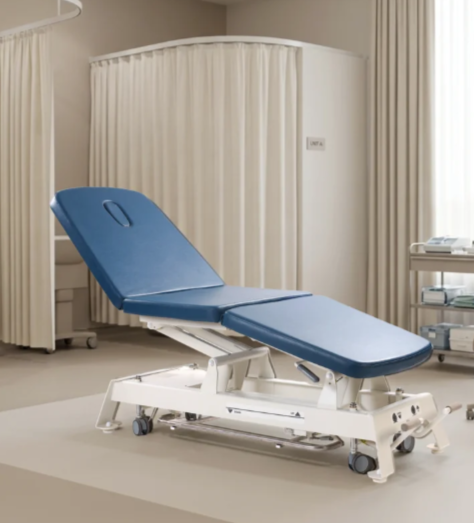
Positioning Sets the Working Height for Everyone: Electric height adjustment allows one table to serve a seated practitioner, a standing practitioner and a patient who needs a low transfer height. Physiotherapy plinths that drop close to floor level support gait work, while fixed-height surfaces force either the patient to climb or the clinician to work at an angle that becomes uncomfortable across a full list.
Access on Three Sides Changes Room Turnover: Clearance around three sides of a table determines how many people can work at once without repositioning the patient. Chairs with a smaller base and a controlled rotation range let staff approach from the side rather than the foot, which shortens the time spent moving equipment and keeps the patient settled for the full procedure.
Section Count Follows the Procedure Being Performed: A two-section examination table suits general consultation, and a seven-section table gives independent control of the head, back, legs and pelvis for longer procedures. Dermatology rooms work better with a derma chair that tilts and holds programmable positions, and infusion or recovery bays need a recliner that reaches a near-flat rest position.
Electric Control Compared with Manual Adjustment: Manual tables cost less and have fewer components to service, which suits low-volume rooms and satellite sites. Motorised tables carry a higher initial price and need a power supply, yet they hold position under load, adjust without interrupting the procedure and remove the physical effort that manual cranks transfer to staff across a busy day.
See also: Emerging Trends in Business Workflow Management
Frame and Upholstery Decide the Replacement Cycle: Powder-coated steel frames and disinfectant-resistant upholstery extend service life in rooms cleaned several times a day. Materials selected for infection prevention and control resist the alcohol-based agents that crack ordinary vinyl within a year, which protects both the surface finish and the cleaning protocol the clinic has already committed to across every room.
Accessories Decided at Specification Stage: Armrests, stirrups, paper roll holders, IV poles and side rails mount differently depending on the frame, and retrofitting them later is rarely clean. A medical furniture supplier for UAE clinics can confirm mounting points, load ratings and trolley compatibility before the order is placed, which keeps the room free of freestanding items that consume floor space.
Patterns Worth Checking Ahead of Installation: Certain patterns appear repeatedly in rooms that were furnished without a layout review. Recognising them early gives your clinic time to correct the specification before installation, and a medical furniture supplier for UAE facilities can usually identify most of them from a floor plan and a short description of the procedures the room will host.
A treatment room planned around its furniture supports faster turnover, safer transfers and less strain on staff across the full life of the equipment. Every month a mismatched layout stays in use, the workaround hardens and correcting it costs live appointment hours. Speak to a medical furniture supplier for UAE clinics before your next fit-out is finalised and book a room-by-room specification review.